 Admin
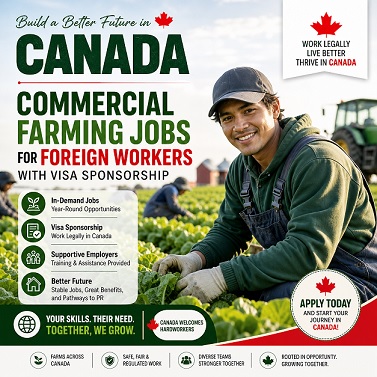
AdminCommercial farming jobs for foreign workers with visa sponsorship in Canada remain one of the most structured and legally secure immigration pathways available to international applicants seeking employer sponsored work permits, agricultural LMIA jobs, and permanent residence opportunities.
With chronic labour shortages across primary agriculture, greenhouse production, livestock management, and agri-food processing, Canadian employers continue to recruit foreign nationals under regulated federal immigration programs. These programs are designed to ensure labour market integrity while providing compliant pathways for temporary work permits and long-term permanent residence (PR).
This authority guide provides a detailed breakdown of:
- Agricultural job categories eligible for sponsorship
- Employer sponsored work visa types
- Salary expectations and overtime structures
- LMIA process and employer compliance
- International recruitment agencies and contact details
- Visa application requirements and documentation
- Embassy verification procedures
- PR pathways and settlement benefits
This content is optimized for employer sponsored work visas, work permits, permanent residence programs, skilled migration pathways, and international agricultural recruitment.
Understanding Canada’s Agricultural Labour Shortage
Canada’s agri-food sector contributes significantly to GDP and export revenues. However, labour supply has not kept pace with expansion in:
• Greenhouse vegetable production
• Meat processing facilities
• Dairy and poultry operations
• Large-scale grain farms
• Fruit orchards and berry farms
To stabilize food production, the federal government authorizes foreign labour recruitment under structured programs administered by:
- Immigration, Refugees and Citizenship Canada
- Employment and Social Development Canada
These authorities regulate LMIA approvals, work permits, and permanent immigration programs.
Types of Commercial Farming Jobs with Visa Sponsorship
Foreign workers may be sponsored for the following agricultural occupations:
1. General Farm Workers
Duties include:
• Planting and harvesting crops
• Feeding livestock
• Cleaning barns
• Sorting produce
• Operating basic farm machinery
NOC categories: TEER 4 and 5 (depending on duties).
2. Greenhouse Production Workers
Canada has one of North America’s largest greenhouse industries. Jobs include:
• Vegetable cultivation
• Irrigation system monitoring
• Crop inspection
• Packing and quality control
High-demand provinces:
• Ontario
• Alberta
• British Columbia
3. Dairy and Livestock Workers
Tasks include:
• Milking operations
• Animal health monitoring
• Feeding management
• Barn sanitation
Livestock farms frequently sponsor under the Agri-Food Pilot for permanent residence eligibility.
4. Meat Processing and Agri-Food Workers
Processing plants employ foreign workers in:
• Slaughter operations
• Meat cutting
• Packaging
• Food safety compliance
Major employers are federally regulated and frequently LMIA-approved.
Salary Ranges and Earnings Potential (2026 Estimates)
The following table provides updated wage expectations.
| Occupation | Hourly Wage (CAD) | Monthly Income | Overtime Eligible | PR Pathway |
|---|---|---|---|---|
| Farm Labourer | $15 – $20 | $2,400 – $3,200 | Yes | Yes |
| Greenhouse Worker | $16 – $22 | $2,600 – $3,500 | Yes | Yes |
| Dairy Worker | $18 – $25 | $2,900 – $4,000 | Yes | Yes |
| Meat Processing Worker | $18 – $26 | $3,000 – $4,200 | Yes | Yes |
| Farm Supervisor | $22 – $32 | $3,800 – $5,000 | Yes | Yes |
Additional benefits may include:
• Employer-provided accommodation
• Transportation assistance
• Health coverage
• Workplace safety insurance
• Paid vacation
Employer Sponsored Visa Options for Agricultural Workers
Canada does not issue “open farm visas.” All agricultural work permits are employer-specific.
The main programs include:
Temporary Foreign Worker Program (TFWP)
Temporary Foreign Worker Program allows employers to hire foreign nationals when no Canadian citizens or permanent residents are available.
Key Requirements:
- Employer applies for LMIA
- Positive LMIA confirms labour shortage
- Worker applies for employer-specific work permit
- Visa issued after background and medical checks
Validity: 1–2 years (renewable).
Seasonal Agricultural Worker Program (SAWP)
Seasonal Agricultural Worker Program supports temporary seasonal labour recruitment.
Key features:
• Seasonal contracts (up to 8 months)
• Employer-provided housing
• Guaranteed minimum work hours
Agri-Food Pilot (PR Pathway)
Agri-Food Pilot provides permanent residence to experienced agricultural workers.
Eligibility:
• 1 year full-time Canadian experience
• Job offer in eligible industry
• CLB 4 language minimum
• High school diploma
Express Entry (Skilled Agricultural Roles)
Express Entry may apply to supervisory or technical agricultural occupations.
Streams include:
• Federal Skilled Worker
• Canadian Experience Class
• Provincial Nominee Programs
Step-by-Step Process to Get Visa Sponsorship
Step 1: Secure a Legitimate Job Offer
The employer must provide:
• Written contract
• Wage breakdown
• LMIA reference number
• Job description
Step 2: LMIA Approval
Employers apply through Employment and Social Development Canada.
A positive LMIA confirms:
• No Canadian available
• Wages meet provincial standards
• Working conditions comply with law
Step 3: Apply for Work Permit
Submit application via Immigration, Refugees and Citizenship Canada online portal.
Required:
• LMIA copy
• Job offer letter
• Passport
• Supporting documents
Step 4: Biometrics and Medical Exam
Applicants must:
• Provide fingerprints
• Undergo panel physician medical examination
Step 5: Embassy Verification
Applicants attend a Visa Application Centre (VAC) for document verification.
Embassy officers verify:
• Employer authenticity
• LMIA validity
• Criminal background
• Medical clearance
Visa Requirements for Agricultural Employment
Standard documentation includes:
• Valid passport (6+ months validity)
• Police clearance certificate
• Medical examination results
• Employment contract
• LMIA confirmation
• Proof of qualifications (if required)
• Proof of work experience
For PR pathways:
• Language test results (IELTS or CELPIP)
• Educational Credential Assessment
International Recruitment Agencies for Farm Jobs
Foreign applicants may work with licensed recruiters such as:
F.A.R.M.S.
Address: 6848 Wellington Road 7, Elora, Ontario, Canada
Website: https://www.farmsontario.ca
Workvantage International Workforce Solutions
Address: 1050 Burrard Street, Vancouver, BC, Canada
Website: https://www.workvantage.ca
Agricultural Employment Alberta Ltd.
Address: 10020 101A Avenue NW, Edmonton, Alberta, Canada
Website: https://www.aealberta.ca
Important compliance advisory:
Canadian law prohibits employers from charging recruitment fees to foreign workers.
Companies Offering Visa Sponsored Agricultural Jobs
Examples of large agri-food employers include:
• Maple Leaf Foods
• Cargill Canada
• HyLife Foods
• Nature Fresh Farms
• SunSelect Produce
Applicants should apply through official career portals.
Embassy Contacts for Nigerian Applicants
High Commission of Canada to Nigeria
Address: 13010G Palm Close, Diplomatic Drive, Central Business District, Abuja
Website: https://www.canadainternational.gc.ca
VAC services in Lagos are handled by authorized service providers listed on the IRCC website.
Mistakes to Avoid in the Sponsorship Process
- Paying unauthorized agents
- Accepting fake LMIA documents
- Submitting incomplete forms
- Using falsified employment records
- Overstaying temporary visa
Immigration misrepresentation can lead to 5-year bans.
Transition to Permanent Residence and Settlement Benefits
Foreign workers may qualify for:
• Provincial Nominee Programs
• Agri-Food Pilot
• Express Entry
Settlement benefits include:
• Public healthcare access
• Family sponsorship rights
• Child education benefits
• Pathway to citizenship
• Freedom to change employers after PR
Provincial Breakdown: Where Agricultural Jobs Are Concentrated
Commercial farming opportunities vary significantly by province. Immigration outcomes often depend on provincial labour demand and nominee programs.
Ontario
• Greenhouse vegetable production
• Fruit orchards
• Dairy farms
• Meat processing facilities
PR advantage: Ontario Immigrant Nominee Program (OINP).
Alberta
• Cattle ranching
• Feedlots
• Large-scale grain farming
PR advantage: Alberta Advantage Immigration Program.
British Columbia
• Berry farms
• Greenhouse vegetable production
• Poultry operations
PR advantage: BC Provincial Nominee Program.
Manitoba
• Pork production
• Grain and oilseed farms
PR advantage: Manitoba Provincial Nominee Program.
Salary Comparison by Province (2026 Estimates)
| Province | Entry-Level Farm Worker | Dairy Worker | Supervisor | Housing Provided |
|---|---|---|---|---|
| Ontario | $16 – $20/hr | $20 – $25/hr | $24 – $32/hr | Often |
| Alberta | $17 – $22/hr | $21 – $27/hr | $25 – $35/hr | Often |
| BC | $16 – $21/hr | $19 – $24/hr | $23 – $30/hr | Sometimes |
| Manitoba | $15 – $19/hr | $18 – $23/hr | $22 – $28/hr | Often |
Overtime typically applies after 44–48 hours depending on provincial labour codes.
Detailed PR Strategy for Agricultural Workers
Foreign workers should plan immigration in phases:
Phase 1: Secure Employer-Specific Work Permit
Apply under:
- Temporary Foreign Worker Program
Employer obtains LMIA approval via Employment and Social Development Canada.
Phase 2: Gain Canadian Work Experience
Minimum:
• 12 months full-time employment (for PR pilots)
• Maintain lawful status
• Avoid gaps in employment
Phase 3: Apply for Permanent Residence
Options include:
Agri-Food Pilot
- Agri-Food Pilot
Express Entry
- Express Entry
Provincial Nominee Programs
Each province nominates workers in high-demand occupations.
Cost of Living Analysis for Farm Workers
Understanding settlement costs is critical before migration.
Estimated Monthly Costs (Rural Areas)
| Expense | Estimated CAD |
|---|---|
| Shared Housing | $400 – $800 |
| Food | $300 – $500 |
| Transport | $150 – $300 |
| Phone/Internet | $80 – $120 |
| Miscellaneous | $200 – $300 |
If employer housing is provided, savings potential increases significantly.
Settlement Benefits After PR
Permanent residents receive:
- Provincial healthcare coverage
- Public school access for children
- Social insurance number (SIN)
- Employment mobility
- Eligibility for citizenship after residency period
Workers may sponsor spouses and dependent children.
Visa Requirements – Advanced Compliance Guide
Applicants must demonstrate:
• Genuine employment relationship
• Ability to perform physical labour
• No criminal inadmissibility
• Medical admissibility
• Intent to comply with visa terms
Supporting documentation includes:
• Detailed employment reference letters
• Educational certificates (if applicable)
• Police clearance certificates
• Medical examination from panel physician
Applications are submitted online through Immigration, Refugees and Citizenship Canada.
Embassy Verification and Work Permit Processing
For applicants in Nigeria:
High Commission of Canada to Nigeria
Address: 13010G Palm Close, Diplomatic Drive, Central Business District, Abuja
Processing steps:
- Online submission
- Biometrics at Visa Application Centre
- Background verification
- Medical clearance
- Passport request
- Visa issuance
Officers verify:
• LMIA authenticity
• Employer registration
• Wage compliance
• Recruitment history
International Recruitment Agencies (Verified Channels)
Applicants may explore structured recruitment through:
F.A.R.M.S.
Ontario-based seasonal agricultural recruiter.
Workvantage International Workforce Solutions
Vancouver-based workforce solutions firm.
Agricultural Employment Alberta Ltd.
Alberta-focused agricultural recruitment.
Applicants must ensure:
• No illegal placement fees
• Written employment contract
• LMIA copy verification
Major Companies Sponsoring Agricultural Workers
Examples include:
• Maple Leaf Foods
• Cargill Canada
• HyLife Foods
• Nature Fresh Farms
• SunSelect Produce
These companies often advertise via:
• Job Bank Canada
• Company career portals
• Provincial recruitment platforms
Possible Official Websites to Apply
• https://www.jobbank.gc.ca
• https://www.canada.ca
• https://www.indeed.ca
Applicants should confirm postings indicate LMIA support or employer sponsorship.
Common Immigration Errors to Avoid
- Using fake job offers
- Submitting altered LMIA documents
- Ignoring medical examination deadlines
- Providing incomplete travel history
- Misrepresenting prior visa refusals
Misrepresentation can result in inadmissibility for up to five years.
Interview Preparation Strategy
Officers may assess:
• Knowledge of employer and job duties
• Understanding of contract terms
• Intent to return after temporary stay (if applicable)
• Previous international travel compliance
Recommended preparation:
• Review employment contract thoroughly
• Confirm employer address and phone number
• Carry LMIA reference number
• Bring complete documentation file
Long-Term Career Growth in Canadian Agriculture
After securing PR, foreign workers may progress to:
• Farm supervisor
• Agricultural technician
• Agribusiness manager
• Independent farm ownership
Canada’s rural development policies continue to expand agricultural modernization, creating upward mobility for experienced workers.
Final Strategic Recommendations
To successfully secure commercial farming jobs with visa sponsorship:
- Target provinces with high agricultural demand
- Verify LMIA authenticity before paying fees
- Maintain lawful immigration status
- Plan PR transition from day one
- Avoid unauthorized agents
- Use official government portals only
Commercial farming jobs in Canada remain one of the most accessible employer sponsored immigration pathways for foreign nationals seeking lawful work permits and long-term permanent residence.


 Admin
Admin